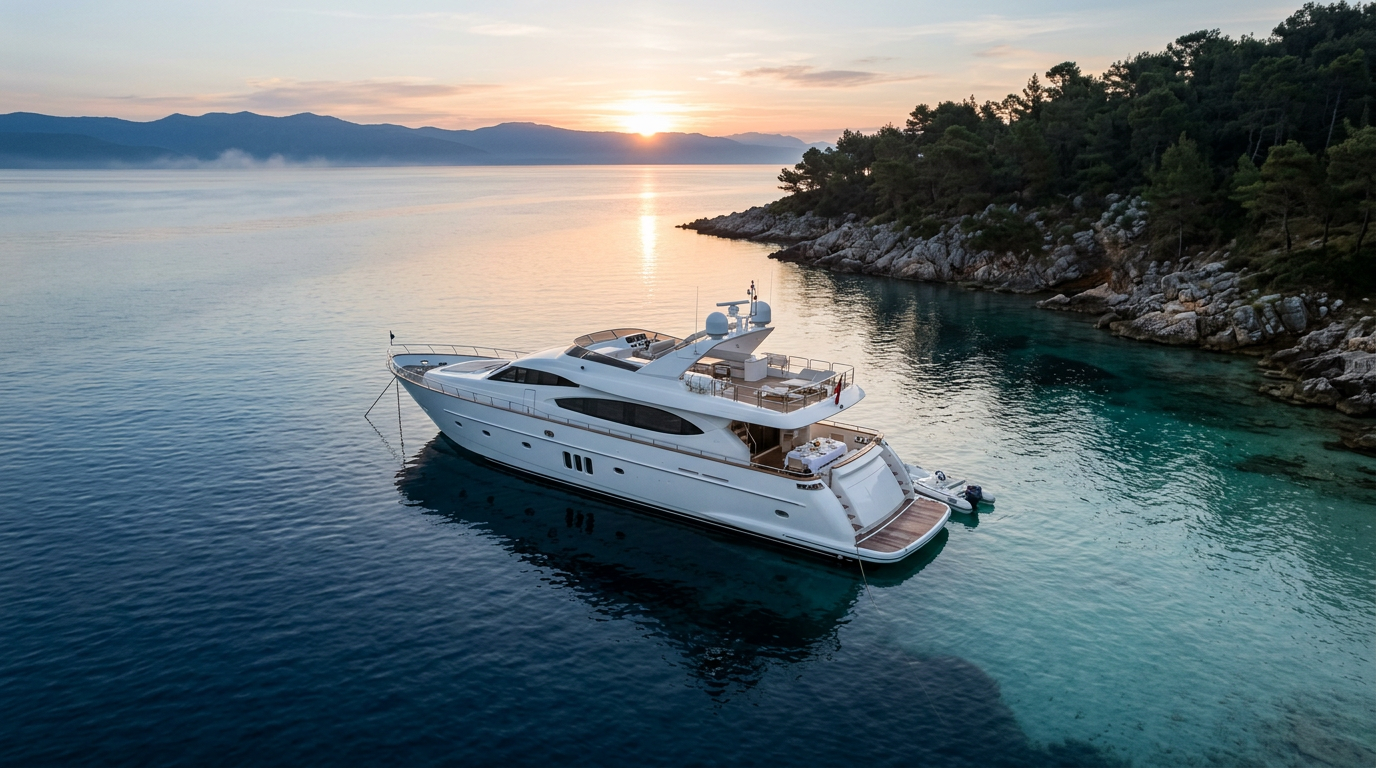
Luxury yacht marketing has a structural problem that most categories would envy and few would know what to do with: the product is spectacular, the audience is tiny, and the purchase takes over a year. Roughly 65% of yacht buyers now begin their search online, and the average superyacht buyer has moved from his late fifties to his mid forties over the past two decades. The channels the category has historically relied on - print in glossy marine titles, boat show floor presence, brokerage relationships - were built for the older buyer. The budgets have not moved as fast as the buyer has.
We build paid media programs for brands where customer lifetime value exceeds $5,000 and the sales cycle runs past 30 days. Marine sits at the extreme end of both: a $12 million new-build carries a consideration window of twelve to eighteen months and a decision unit that includes a spouse, a captain, a broker and often a wealth advisor. This playbook covers what actually works across the three distinct businesses in the category - new-build shipyards, brokerage houses and charter operators - because they are frequently marketed as one thing and should never be.
Why luxury yacht marketing starts with audience arithmetic
Start with honest arithmetic, because luxury yacht marketing fails more often from bad audience sizing than from bad creative.
The global luxury yacht market is valued at roughly $10.8 billion in 2026, projected toward $14.6 billion by 2031. Against that, the addressable US audience for a serious yacht purchase looks approximately like this:
- Households with investable assets above $5 million: roughly 1.8 million in the US
- Of those, households with any demonstrated marine affinity - ownership, charter history, marina proximity, boat show attendance, category content consumption: roughly 250,000 to 400,000
- Genuine in-market buyers in any twelve-month window for vessels above $2 million: plausibly 6,000 to 12,000 households
That last number should reframe the entire media plan. You are not running a reach campaign. You are running a precision frequency campaign against a universe smaller than a mid-sized town, and the correct instinct is to spend more per household, not to spend less per thousand impressions. A CPM of $60 against a verified marine-affinity high-net-worth household is a bargain; a CPM of $18 against modeled "affluent males 35-64" is a donation.
Three businesses, three audience architectures
| New-build shipyard | Brokerage | Charter | |
|---|---|---|---|
| Typical transaction value | $3M–$50M+ | $500K–$20M | $30K–$500K per week |
| Consideration window | 12–18 months | 4–9 months | 3–10 weeks |
| Primary decision driver | Trust in the yard, delivery slot, customization | Inventory access and broker relationship | Itinerary, crew, timing |
| Core audience signal | Existing ownership, wealth events, competitor-brand affinity | Ownership + life-stage triggers + listing intent | Travel intent, luxury hospitality behavior |
| Best-performing channels | Premium CTV, high-end print, endemic sponsorship, DOOH at shows | Search, programmatic display, retargeting, endemic native | Paid social, streaming audio, travel-endemic native, CTV |
| Realistic annual media budget | $600K–$2.5M | $150K–$600K | $200K–$900K |
| Measurement approach | Brand lift + qualified inquiry cost + incrementality | Inquiry-to-viewing rate + geo holdout | Bookings with multi-touch + holdout |
The failure mode we see most often is a shipyard running charter-style performance tactics - short-window retargeting, aggressive offer creative, cost-per-click optimization - against a purchase that no one makes in the same quarter they first see an ad. It generates a clean-looking dashboard and no boats.
Build the audience in three concentric layers regardless of which business you are in:
- Known and owned. Your CRM, past inquiries, show badge scans, service records, newsletter subscribers. Onboarded to a DSP, this is the cheapest and highest-performing layer you will ever buy, typically adding only $0.50 to $1.50 CPM.
- Behaviorally verified. Marine registry data, marina slip records where licensable, charter booking history, marine insurance signals, competitor-brand site visitation via approved data partnerships. This is the segment that separates real yacht marketing from generic luxury marketing.
- Modeled expansion. Lookalikes seeded on layer one, plus wealth and property-value overlays. Cap this layer - it should be a reach extension, not the core, and it degrades quickly past a 2% similarity threshold.
More on building layer three properly in our guide to affluent lookalike modeling.
Premium CTV in luxury yacht marketing: a buyer who got fifteen years younger
The demographic shift is the single most actionable fact in the category. A buyer in his mid forties - increasingly from technology, private equity or real estate wealth rather than inherited industry - does not read the same magazines his predecessor did, and is streaming rather than watching linear. Connected TV is now the most efficient way to put a ninety-second vessel film in front of that household on a large screen.
What works in practice:
- Environment over reach. Prestige drama, documentary, competitive sailing and golf coverage, high-end travel programming. Expect $45 to $65 CPM on curated premium supply with a marine-affinity or verified-wealth layer. Do not chase the $22 CPM alternative; the sub-$25 CTV market is where general-entertainment library inventory lives.
- Long-form creative. This is one of the few categories where 60- and 90-second CTV units genuinely outperform 15s and 30s. The product needs time. Buy premium pods where extended lengths are accepted rather than cutting the film down to fit cheap inventory.
- Sequential storytelling. A three-part sequence - vessel, yard and craft, ownership experience - executed across a stable household identifier significantly outperforms rotation. Our notes on creative sequencing in CTV apply almost unchanged here.
- Frequency discipline. Target 4 to 6 exposures per household per month. Against a 300,000-household universe it is entirely possible to hit 20+ monthly frequency by accident, which converts an expensive brand asset into an irritant.
Streaming audio deserves a specific mention. Sailing and marine podcasts are small, and that is the point - a $35 to $55 CPM host-read placement in a show with 40,000 listeners who all own boats is a far better buy than a broad music-streaming audience layer at $14.
Boat show weeks are the only real seasonality in luxury yacht marketing
Almost no consumer category has demand this concentrated. Fort Lauderdale in late October, Miami in February, Palm Beach in March, Monaco in September, Cannes in September, Düsseldorf in January - these weeks compress a disproportionate share of annual qualified inquiry into a handful of geographies.
The media implication is a geographic and temporal surge model rather than a flat annual plan:
- T-minus 6 weeks: begin CTV and endemic native weight against national marine-affinity audiences, plus attendee-modeled segments.
- T-minus 2 weeks: layer DOOH against approach corridors, luxury hotel districts, private aviation terminals and marina access roads in the host city. Programmatic DOOH lets you buy this at a two-week flight rather than a four-week minimum.
- Show week: geofenced mobile and DOOH within the venue radius, plus dayparted streaming audio against morning and evening commute windows in the host DMA. Budget 25% to 40% of annual media into the four show weeks that matter to your business.
- T-plus 8 weeks: retargeting and sequential CTV against device IDs observed at the venue, plus CRM-matched follow-up against badge data. This is where most operators stop spending and where a meaningful share of the eventual transactions are actually won.
Fort Lauderdale alone justifies a dedicated DOOH plan; our approach to DOOH affluent location targeting covers the venue and corridor selection logic in more detail.
Creative principles for a category that photographs better than it explains
Four rules that hold across every marine client we have worked with:
- Show the vessel underway, not at anchor. Motion converts. Static beauty shots read as stock photography, and the category is saturated with them.
- Lead with the yard, not the boat, for new-build. A buyer choosing a shipyard is choosing an eighteen-month relationship and a resale value. Craft, welding, joinery, hull-form engineering - the workshop footage outperforms the glamour footage on qualified-inquiry rate.
- Never put a price in the creative. In this category price disclosure filters out the buyer who would have negotiated and signals discounting to the one who would not.
- Design for a decision unit, not a decision maker. The spouse frequently vetoes and the captain frequently specifies. Interior, crew accommodation and operating-cost narratives need their own creative, not a footnote in the hero film.
A note on production economics, because it distorts more marine media plans than anything else. A proper vessel film costs $80,000 to $250,000 to shoot - sea days, drone permits, crew, a weather window that may not arrive on schedule. That number is usually approved before anyone has decided how the film will be distributed, and the media budget then becomes whatever is left. The result is a category full of exceptional footage seen by almost nobody. A defensible split for a new-build program is roughly 20% production to 80% media, and a film shot with distribution in mind - captured with 90-second, 30-second, 15-second and vertical cutdowns planned into the shot list rather than salvaged in the edit - costs no more to make and is worth several times as much once it reaches a DSP.
The related discipline is asset shelf life. Vessel footage stays usable for three to five years, far longer than creative in most categories, which means the right comparison is production cost against multi-year media weight rather than against a single campaign flight.
Measuring a fourteen-month sales cycle
Last-click attribution is worse than useless here - it is actively misleading, because the final touch before an inquiry is almost always branded search, which will absorb credit for every dollar of upper-funnel work that created the search in the first place.
What we run instead:
- Geo holdout tests. Hold 20% to 30% of comparable DMAs out of the surge plan around a show cycle and compare qualified inquiry rates. This is the cleanest causal read available in a category with too few conversions for user-level testing. Design details are in our guide to holdout testing.
- Qualified inquiry as the primary KPI, with qualification defined jointly with the sales team before the campaign launches. Benchmark cost per qualified inquiry: $400 to $1,200 for brokerage, $1,500 to $6,000 for new-build. Both look alarming until divided into the transaction value.
- Brand lift studies run against the marine-affinity segment, measuring consideration rather than recall. Recall is easy in a category with beautiful creative and tells you nothing.
- A pipeline-stage bridge. Map media exposure to CRM stage progression rather than to conversion, since the conversion may land three fiscal quarters after the spend. The framework in our piece on the high-consideration purchase funnel translates directly.
Set expectations with the board before launch: a new-build program's first honest read arrives at month seven, and anyone promising a quarterly ROAS number for a $12 million vessel is describing branded search, not marketing.
Where most luxury yacht marketing budgets are misallocated
- Too much in endemic print, too little in endemic digital. The marine titles remain valuable for credibility and broker relationships, but they are now a trust signal rather than a demand channel.
- Show spend without surround. A $400,000 show presence supported by $30,000 of media is a very expensive way to talk to people already standing on your dock.
- Paid social as the primary channel. It has a real role in charter and a limited one in brokerage; it is close to irrelevant for a $20 million new-build decision made by a household that does not respond to ads in a feed.
- No first-party data infrastructure. Every yard and brokerage sits on years of inquiry data that is worth more than any segment they could license. Most of it has never been onboarded.
If you are building a media program for a shipyard, brokerage or charter operator and want a plan grounded in audience arithmetic rather than category convention, apply to work with Stillwater Media. We take a limited number of engagements each quarter, and we start marine engagements by sizing the real buyer universe before anyone talks about channels.
Frequently Asked Questions
How do you market a luxury yacht effectively in 2026?
Effective luxury yacht marketing starts with audience arithmetic rather than channels: the realistic in-market universe for vessels above $2 million is only about 6,000 to 12,000 US households annually, which makes precision and frequency far more important than reach. Build concentric audiences from first-party CRM data outward, run long-form premium connected TV against a buyer who is now typically in his mid forties, and concentrate 25–40% of annual budget into the four boat show weeks that matter to your business.
How much should a yacht brand spend on advertising?
Annual media budgets typically run $600,000 to $2.5 million for a new-build shipyard, $150,000 to $600,000 for a brokerage, and $200,000 to $900,000 for a charter operator. The variance is driven by transaction value and consideration length rather than company size. Because the addressable audience is so small, these budgets should be spent on high-CPM verified inventory rather than distributed thinly across cheap reach.
What is the best channel for reaching yacht buyers?
Premium connected TV is currently the strongest single channel for new-build and brokerage, because it delivers long-form vessel and shipyard footage on a large screen to a buyer demographic that has shifted to streaming. It works best paired with endemic marine podcasts, programmatic DOOH concentrated around boat show host cities, and retargeting against first-party inquiry data. Paid social has a real role in charter marketing and a limited one in multi-million-dollar vessel sales.
How do you measure marketing for a purchase that takes over a year?
Use geo holdout testing as the primary causal read - hold 20–30% of comparable markets out of a campaign flight and compare qualified inquiry rates - because a fourteen-month cycle produces too few conversions for reliable user-level attribution. Pair that with cost per qualified inquiry as the operating KPI, brand lift studies measuring consideration rather than recall, and a bridge that maps media exposure to CRM pipeline-stage progression instead of to closed sales.
Who buys superyachts today?
The buyer profile has shifted markedly: the average superyacht buyer's age has fallen from roughly 58 to the mid forties over two decades, with US and Asian buyers skewing younger still, and wealth increasingly originating in technology, private equity and real estate rather than inherited industry. Around 65% of yacht buyers now begin their search online, and the decision unit typically includes a spouse, a captain and often a wealth advisor - which means creative needs to address interiors, crew and operating costs, not only the vessel itself.