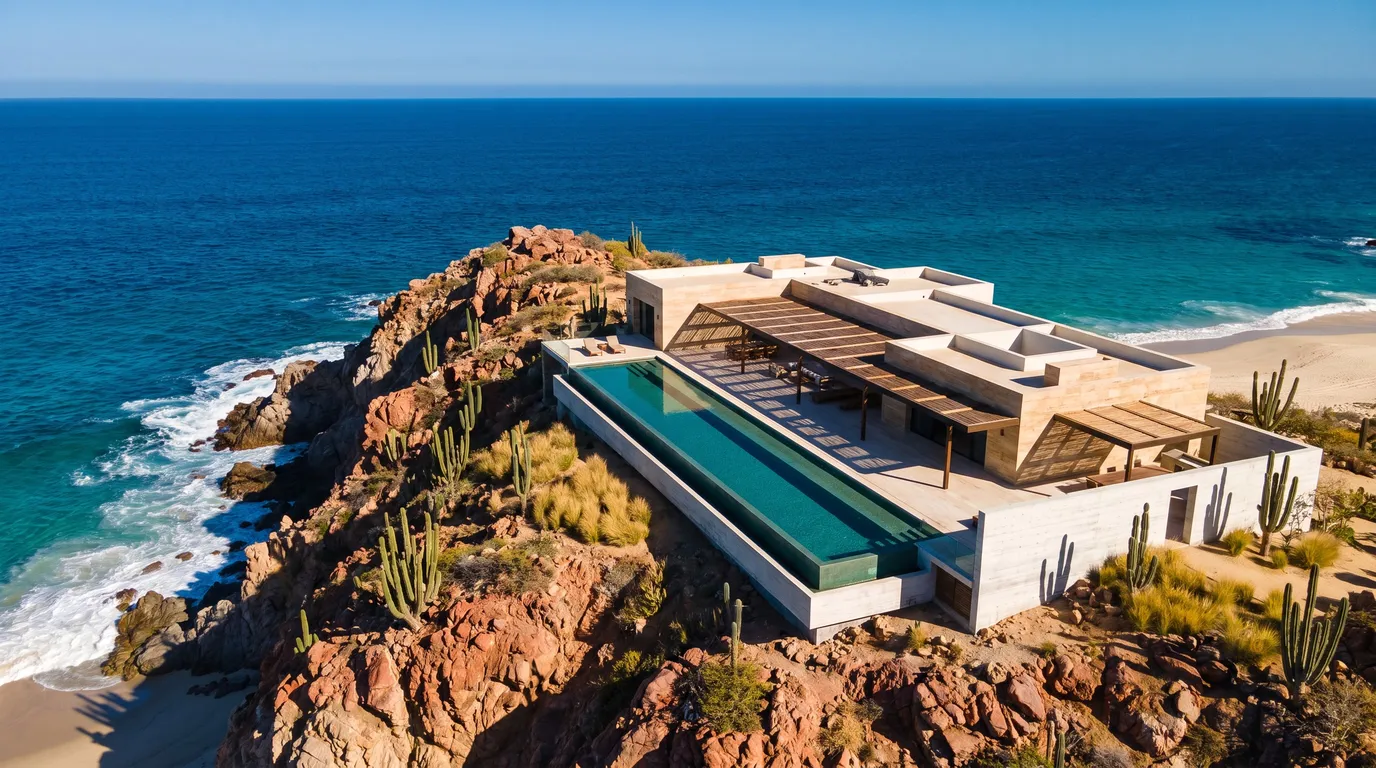
Mexico luxury real estate advertising has a clear target: the American and Canadian households who buy most of the country's coastal and colonial-heartland luxury inventory. For a developer selling beachfront residences on the Pacific coast or in the Riviera Maya, a branded-residence project inside a resort, or a hillside villa community in the central highlands, the buyer usually lives in another country, has never stood on the site, and will take six to eighteen months to decide.
That reality changes everything about the media plan. This guide covers who cross-border buyers are, where to reach them, what the restricted zone and bank trust rules mean for your messaging, how much a credible program costs, how to measure it, and the mistakes that most often waste a launch budget.
Who buys luxury real estate in Mexico from across the border?
Most foreign demand for Mexican luxury property comes from the United States and Canada, with smaller but valuable flows from Europe and from wealthy Mexican families living abroad. The buyer types are distinct:
- Second-home buyers who want a winter residence within a short flight of home. They often combine lifestyle and rental income goals.
- Pre-retirees and early retirees planning to spend part or most of the year in Mexico. They are wealth-rich, time-rich and research-heavy.
- Remote executives and entrepreneurs who can work from anywhere and want a base with good connectivity and quality of life.
- Investors buying pre-construction or branded residences for appreciation and managed rental returns.
- Mexican nationals living abroad buying back into the home market, often with very different questions from American buyers.
The relationship also runs both ways. Mexican buyers are among the largest foreign purchasers of US homes; the National Association of Realtors reported that Mexico accounted for about 14% of foreign buyers of US residential property in the year to March 2026, as summarized in NAR's newsroom release. The cross-border corridor is busy in both directions, and both sides of it are reachable with the same premium media.
Why does Mexico luxury real estate advertising need a different approach?
Selling a $2 million residence in Mexico to a buyer in another country is not the same task as selling a home locally. Four differences shape the plan:
- Distance and trust. The buyer cannot drive by the site. Media has to build enough confidence to justify a flight and a site visit.
- Legal unfamiliarity. Most foreign buyers have heard something vague about ownership limits. Unanswered legal questions quietly kill deals.
- Long, seasonal cycles. Interest peaks when it is cold at home, but decisions often close months later.
- Two currencies and two tax systems. Pricing in dollars, financing limits and cross-border tax questions all influence timing.
The best Mexico luxury real estate advertising programs treat these as content and creative problems, not just targeting problems.
How do the restricted zone and bank trust rules affect your messaging?
Mexico's constitution limits direct foreign ownership of land in the "restricted zone," a strip 100 kilometers wide along land borders and 50 kilometers wide along coastlines. According to Garrigues' analysis of Mexico's foreign investment rules for real estate and Mexican consular guidance, foreigners acquire residential property in that zone through a bank trust, known as a fideicomiso, with a permit from the Ministry of Foreign Affairs. The trust typically runs for 50 years and is renewable, and the beneficiary holds the rights to use, rent, sell or bequeath the property. Outside the restricted zone, foreigners can generally hold title directly.
Because almost every coastal luxury project sits inside the restricted zone, your advertising should address the question head-on:
- Explain it simply. A short, plain-language explainer video or article on how the bank trust works, reviewed by Mexican counsel, outperforms vague reassurance.
- Do not overstate. Avoid phrases such as "own it outright" for restricted zone property. Accuracy builds trust; overstatement creates legal risk.
- Name the professionals. Show that buyers will work with an independent notary, a bank trustee and qualified counsel.
This is general information, not legal advice. Every developer should have its claims reviewed by Mexican counsel before media launches.
Which channels work best for Mexico luxury real estate advertising?
The core of a cross-border plan is premium video, curated programmatic and high-intent search, all aimed at feeder markets in the US and Canada. The table compares the main options.
| Channel | Role in the plan | Targeting approach | Key watch-out |
|---|---|---|---|
| Premium CTV (Disney+, Netflix, Prime Video, premium FAST) | Make the destination and the project feel real at scale | Household wealth, geography, travel interest | Needs strong 30 and 60 second cinematic creative |
| YouTube Select and long-form video | Deep dives: tours, neighborhood guides, legal explainers | Contextual travel and real estate content, customer lists | Generic YouTube inventory dilutes brand safety |
| Curated programmatic display and video (PMP) | Frequency and retargeting across trusted publishers | First-party, contextual, wealth segments | Avoid open exchange and made-for-advertising sites |
| Paid search | Capture active research on the destination and the bank trust | Keywords on area, ownership, branded residences | Housing ad policies may limit targeting |
| Paid social (Instagram, Facebook) | Visual storytelling, events, retargeting | Broad audience, interest, retargeting | Housing special ad category rules for US audiences |
| Streaming audio and podcasts | Reach retirement, wealth and travel listeners | Show context and audience profile | Measurement needs geo or code-based testing |
| DOOH in airports and private terminals | Reach affluent winter travelers in motion | Venue and time of year | Use alongside, not instead of, digital |
Two practices make the plan work. First, buy premium supply through private marketplace and programmatic guaranteed deals; our open exchange vs private marketplace programmatic analysis explains why. Second, concentrate spend in a few proven feeder regions rather than the whole of North America, then expand from what works. Our guide for luxury real estate developers selling to out-of-market buyers covers feeder-market selection in more detail.
Do US housing ad rules apply to a property in Mexico?
This is a common blind spot. US fair housing law governs dwellings in the United States, but the ad platforms apply their own housing policies based on where the ad is shown and what it promotes. Meta, for example, requires advertisers running housing ads aimed at US audiences to use its Housing special ad category, which restricts age, gender and ZIP-code targeting and limits detailed targeting options. Google applies similar personalized-advertising restrictions to housing ads in the US and Canada.
In practice, treat a Mexican property marketed to US and Canadian residents as housing advertising on those platforms, and plan creative and audiences accordingly. Our guide to fair housing rules for luxury real estate advertising targeting explains the compliant alternatives: first-party lists with care, contextual targeting, geography at a broad level, and creative that selects for the right buyer on its own.
What creative works for cross-border luxury buyers?
Creative carries more of the targeting work when platform targeting is restricted. The strongest programs share a few traits:
- The light, the water and the quiet. Cinematic footage of the setting, the views and the architecture at different times of day. Make the place feel real before you sell the floor plan.
- Proof of the operator. Show the developer's track record, the hospitality partner for branded residences, and the property management model for rental programs.
- Practical answers. Flight times, healthcare access, the bank trust process, closing costs and rental program terms. Sophisticated buyers want detail, not slogans.
- Discretion. No aggressive discount messaging. Incentives such as founding-buyer pricing are fine, but presented quietly.
- A clear next step. A private video tour, an invitation to a hosted site visit, or a conversation with a bilingual advisor.
Pair this with sequenced storytelling across CTV, YouTube and social, so a buyer who sees a 30-second destination film is followed by a tour, then a legal explainer, then an invitation.
How much should a Mexico luxury real estate advertising program cost?
Budgets depend on inventory value, sales velocity and the number of feeder markets. The ranges below are Stillwater planning ranges, not published rate cards.
| Line item | Stillwater planning range |
|---|---|
| Premium CTV in US and Canadian feeder markets | $40 to $75 CPM |
| YouTube Select and premium online video | $20 to $40 CPM |
| Curated PMP display and video | $8 to $20 CPM |
| Paid search on destination and ownership terms | $3 to $12 per click |
| Pre-launch and launch program (first 6 months) | $150,000 to $450,000 working media |
| Media as a share of sell-out value | 0.75% to 2% for most luxury projects |
A useful sanity check: if a project's average sale is $1.5 million and the developer needs 40 sales in year one, a $300,000 media program costs $7,500 per closed sale, which is small relative to commission and incentive costs.
How should cross-border campaigns be measured?
Measurement has to follow a long, multi-touch journey. A practical framework:
- Qualified inquiries, not clicks. Define a qualified inquiry by budget, timeline and intent, and record source, feeder market and content viewed in the CRM.
- Site-visit bookings. For most coastal projects, the hosted site visit is the most predictive milestone before contract.
- Geo holdout tests across feeder markets to measure incremental lift, using the approach in our geo experiment design guide.
- Branded search lift for the project and destination in feeder markets.
- Long attribution windows of 90 to 365 days, matched to the real sales cycle.
Stillwater planning benchmarks for a well-run program: video completion rates above 90% on premium CTV, 1% to 3% of visitors from curated media becoming qualified inquiries, and 10% to 25% of qualified inquiries booking a site visit within six months.
When is the best time to advertise to cross-border buyers?
Seasonality is strong. Interest from US and Canadian buyers rises as the weather turns cold, so build awareness from late summer and peak spend from October through March, when buyers are both dreaming and traveling. Hosted site visits cluster in winter, so book capacity early. Keep an always-on base through the rest of the year for retargeting and search capture, because closing often happens in spring and summer after a winter visit.
Watch exchange rates and interest rate moves too. A stronger dollar makes Mexican property feel more affordable to Americans, and US rate changes affect buyers who plan to fund purchases from home equity or portfolio loans.
What are the most common mistakes?
- Selling the floor plan before the place. Cross-border buyers buy the destination first.
- Ignoring the bank trust question. Silence reads as risk.
- Overstating ownership or returns. Rental yield and appreciation claims need careful, substantiated language.
- Spreading budget across every US region. Feeder-market focus wins.
- Running housing ads without the right platform category. It can trigger rejections or account restrictions mid-launch.
- Slow, monolingual follow-up. Have bilingual advisors respond quickly in the buyer's time zone.
- Judging results in six weeks. Read early indicators first and sales later.
What should you ask a media agency before you hire one?
- Which luxury real estate projects have you marketed to out-of-market or cross-border buyers?
- How do you handle housing ad category rules on Meta and Google?
- Which premium CTV and PMP deals would you use to reach our feeder markets?
- Who reviews legal and ownership claims in our creative?
- How will you measure incremental lift and site-visit bookings, not just clicks?
- Do you buy media on a principal basis or pass through costs transparently?
Where does Stillwater fit?
Stillwater Media is a selective performance media agency for luxury and high-consideration brands, working with clients nationally and internationally. We plan premium CTV, curated programmatic, DOOH, streaming audio, YouTube Select, podcasts and premium publisher deals, with affluent audience engineering, brand safety controls and incrementality testing in every engagement. Clients include JetLinx, W Hotels, PXG, FLY Exclusive and Financial Independence Group. We take a limited number of engagements each quarter.
If you are launching or selling a luxury project in Mexico to buyers across the border, apply to work with Stillwater Media and we will tell you which feeder markets to prioritize, what a credible launch program would cost and how we would prove it works.
About the author: Stillwater Media is a selective performance media agency for luxury and high-consideration brands. Signal. Strategy. Scale.
Frequently Asked Questions
How do you market Mexican luxury real estate to American buyers?
Focus on a few proven US and Canadian feeder markets with premium CTV, YouTube, curated programmatic and search, and use creative that sells the destination before the floor plan. Answer ownership questions clearly and offer a hosted site visit or private video tour as the next step.
Can Americans own beachfront property in Mexico?
Yes, through a bank trust (fideicomiso) for residential property inside the restricted zone, which covers 50 km along coastlines and 100 km along land borders. The trust typically runs 50 years and is renewable, and buyers should work with a notary and qualified Mexican counsel.
Do housing ad rules apply when advertising Mexican property in the US?
US fair housing law covers US dwellings, but ad platforms apply their own housing policies based on audience location. Meta, for example, requires its Housing special ad category for housing ads aimed at US audiences, so plan targeting and creative for those limits.
How much should a developer spend on Mexico luxury real estate advertising?
As Stillwater planning ranges, a six-month pre-launch and launch program usually needs $150,000 to $450,000 in working media, or roughly 0.75% to 2% of sell-out value. Premium CTV in feeder markets runs about $40 to $75 CPM.
When is the best time to advertise Mexican property to cross-border buyers?
Build awareness from late summer and peak spend from October through March, when US and Canadian buyers are thinking about warm weather and traveling. Keep an always-on base for search and retargeting because many closings happen in spring and summer.