
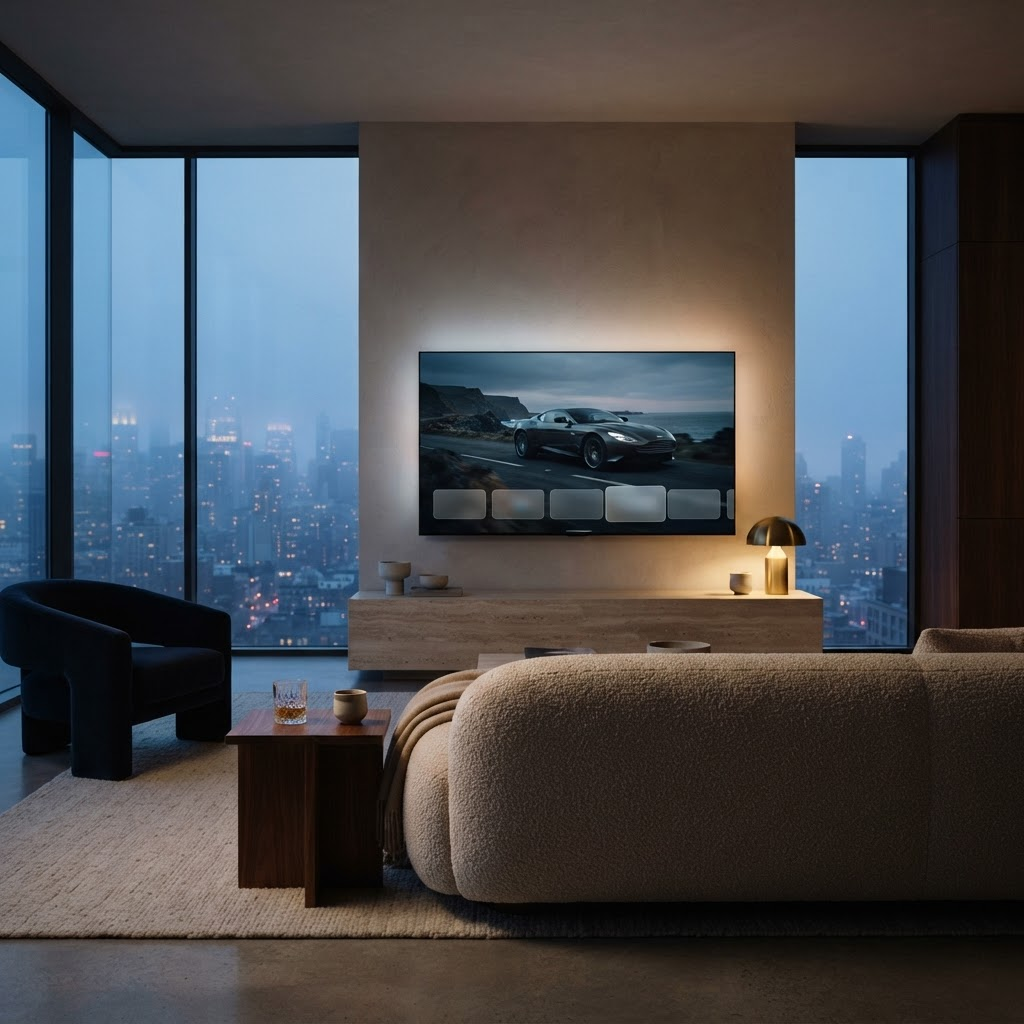
Shoppable CTV advertising has moved from novelty to line item. Roughly one in five connected TV campaigns we plan for luxury and high-consideration clients now carries an interactive component, and the format has matured enough that the honest question is no longer "does it work" but "where does it earn its premium." For a private aviation operator selling $180,000 jet cards or a builder marketing $4M coastal residences, an on-screen interaction is not a purchase - it is a hand raised in a household we could not otherwise identify. That distinction governs every decision below.
The mechanics are simple. A standard 30-second CTV spot runs in a premium streaming environment. Layered on top is an interactive element: a QR code, an on-screen prompt navigable by remote, a "send me more" action that pushes an email or SMS to the account holder, or a companion unit that persists after the video completes. The viewer engages, and something measurable happens - a scan, a request, a site session on a phone in the same household.
What has changed since 2024 is not the technology. It is that enough campaign volume has run through Roku, Amazon, and the major DSPs to produce defensible benchmark ranges, and that identity infrastructure has improved to the point where a scan on a phone can be tied back to the impression that produced it with reasonable confidence.
Why Shoppable CTV Advertising Fits High-Consideration Categories
The received wisdom is that interactive TV formats belong to commerce - beauty, apparel, snacks, anything with a sub-$100 impulse threshold. That framing undersells the format for luxury.
A $12 purchase and a $400,000 purchase share one thing: both require the viewer to leave the passive state. In commerce, the value of leaving that state is the transaction. In high-consideration categories, the value is the identification. A household that scans a QR code during a wealth management spot has self-selected out of an audience of 400,000 impressions into a set of perhaps 900 genuinely curious households. That set is worth more to a firm with a $2.4M average account than any completed rate.
Three structural reasons the format suits our verticals:
- Sales cycles exceed 30 days. Interaction is the only in-flight signal available. Waiting 90 days for closed-won data means optimizing blind for a quarter.
- Household composition matters. CTV is a household medium, and luxury purchases are frequently household decisions. An interaction from a co-viewing environment carries information a single-user mobile click does not.
- Creative can afford to be slow. Luxury CTV creative tends to be atmospheric rather than urgent. An interactive layer gives the atmospheric spot a response mechanism it otherwise lacks.
The failure mode is treating the interaction as the KPI. We have seen agencies report a 0.42% engagement rate as a campaign win while the incremental lift on qualified inquiries was statistically indistinguishable from zero. Engagement is a diagnostic. Incrementality is the verdict.
Interactive CTV Ad Formats Compared
The category is not monolithic. Five distinct formats exist, and they behave very differently for affluent audiences.
| Format | How It Works | Typical Engagement Rate | CPM Premium vs. Standard CTV | Best For |
|---|---|---|---|---|
| QR code overlay | Static or animated code on-screen for 8–15 seconds | 0.15%–0.60% scan rate | +$2 to $6 | Catalog requests, event RSVPs, brochure downloads |
| Remote-navigable interactive | Viewer presses OK to expand an overlay with 2–4 options | 0.30%–1.20% interaction rate | +$8 to $18 | Model/floorplan exploration, dealer or office locator |
| Send-to-device / email capture | One-click push of content to the account email or phone | 0.20%–0.75% action rate | +$6 to $14 | Whitepapers, pricing sheets, private club information |
| Pause ads with action | Branded unit appears when viewer pauses, with a prompt | 0.80%–2.50% interaction rate (of pauses) | +$4 to $10 | Awareness reinforcement, secondary conversion path |
| Shoppable carousel / product gallery | Persistent gallery navigable during or after the spot | 0.25%–0.90% engagement rate | +$10 to $22 | Luxury goods, watches, apparel, accessories with defined SKUs |
Those ranges reflect campaigns we have planned or audited across private aviation, luxury real estate, wealth management, luxury automotive, and premium DTC between mid-2024 and mid-2026. They are not universal. Two variables move them more than anything else:
- Household affluence correlates negatively with scan rate. HNW households scan less. In our data, campaigns targeting $500K+ household income deliver QR scan rates roughly 25–40% below broad-reach benchmarks. Do not read that as failure - read it as a reminder that the denominator changed.
- Dayparts matter enormously. Weekend afternoon and 8–11pm weekday scan rates run 1.5x to 2.2x higher than early-morning inventory. Phones are within reach.
Platform-by-Platform: Where Premium CTV Inventory Supports Interactivity
Not every publisher supports every format, and the gap between what a platform announces and what is actually buyable in a private marketplace deal is often six to twelve months wide.
Roku remains the most complete interactive environment. Action Ads, its remote-navigable format, works natively on the operating system rather than through a player overlay, which means it renders reliably. Roku's home screen Marquee placement is not shoppable in the strict sense but pairs well with an interactive in-stream unit. For luxury brands, the constraint is inventory quality: Roku's reach is broad, so affluent targeting depends heavily on the audience layer rather than the content adjacency.
Amazon offers the tightest closed loop when the advertiser sells anything Amazon can attribute - which for luxury is a narrower set than it sounds. Interactive formats on Prime Video and Fire TV connect to Amazon's purchase and browse graph, which is genuinely useful for premium DTC and luxury goods, and considerably less useful for a private jet operator. Amazon's interactive units carry meaningful CPM premiums, frequently $10+ above the base.
Disney+ and Hulu support pause ads and a growing set of interactive formats through Disney's ad platform. Content adjacency here is the draw for luxury: the environment is premium, brand-safe, and the audience skews toward higher household income than platform averages. Interactive availability in private marketplace deals is improving but should be confirmed deal-by-deal, not assumed.
Netflix entered the interactive space cautiously and its formats remain more limited than competitors'. The inventory quality and the composition of the ad-supported tier still justify inclusion in a luxury plan; the interactivity is a bonus rather than the reason to buy.
Samsung, Vizio, and LG (native OS inventory) support QR and overlay formats and offer ACR-based targeting. These are useful for extending reach at lower CPMs, though creative rendering is less consistent across device generations.
A practical planning note: in every case, confirm that the interactive format is available on the specific PMP deal ID you are transacting, not just on the platform generally. Format availability varies by deal, by geography, and by device.
Building the Campaign: A Six-Step Methodology
1. Define the interaction you actually want
Write down the single action worth the CPM premium before you look at a single format. "Request the model portfolio" is an action. "Engagement" is not. For a private club, it may be "check membership availability." For a wealth management firm, "receive the tax-transition brief." The action determines the format, not the other way around.
2. Model whether the premium can pay for itself
The arithmetic is unforgiving and worth doing on a napkin. If a standard CTV impression costs $38 CPM and the interactive version costs $50, you are paying $12 per thousand - roughly $12,000 on a million impressions - for the interactive layer. At a 0.35% action rate, that is 3,500 actions at about $3.43 each in incremental cost. If your historic action-to-qualified-inquiry rate is 8%, you are paying roughly $43 in premium per qualified inquiry. Against a $5,000+ LTV threshold, that clears easily. Against a thin-margin product, it does not.
3. Design creative for the interaction, not around it
The most common creative mistake is bolting a QR code onto a spot built for passive viewing. Effective interactive CTV creative earns the interaction with roughly eight seconds of on-screen persistence, a verbal cue that references the on-screen element, and a value exchange stated plainly. Scan rates improve 30–60% when the spot verbally acknowledges the interactive element versus displaying it silently.
4. Cap frequency before you optimize anything else
Interactive units are more intrusive than standard spots, and irritation compounds. We hold interactive CTV frequency to 3–4 exposures per household per week, below our standard CTV ceiling. Above roughly six weekly exposures, interaction rates in our data decline while completed rates stay flat - a clean signal of format fatigue rather than audience fatigue.
5. Instrument the landing experience for the second screen
A QR scan lands on a phone, often mid-episode, frequently at low attention. The destination should load in under two seconds, present a single action, and require no more than an email address. Multi-field forms on a scan destination lose 60–75% of arrivals in our observations. Persist the session so a household member can return on a laptop later.
6. Measure with holdout, not with attribution windows
This is where most shoppable CTV programs quietly fail. Interaction data is compelling and easy to over-credit. Design a geographic or audience-level holdout from the start, run it for the full flight, and evaluate lift on qualified inquiries and pipeline rather than on scans. In our own testing, roughly 35–55% of measured post-exposure conversions in interactive CTV campaigns would have occurred without the interactive layer - the layer accelerated them rather than created them. That is still valuable. It is not the same as incremental.
Sequencing Shoppable CTV Inside a Full-Funnel Plan
Interactive formats are a mid-funnel instrument. Deployed as the entire CTV strategy, they underperform; deployed as the second beat in a sequence, they consistently outperform the standard-video control.
The sequence we build for most high-consideration clients runs in three stages:
Stage one - atmospheric reach. Standard 30-second premium CTV against a broad affluent prospecting audience, no interactive layer, no premium paid. The job here is establishing that the brand exists and is of a certain caliber. Typically 55–65% of CTV budget.
Stage two - interactive re-engagement. Households that reached at least 50% completion on the stage-one spot receive the interactive version, usually within seven to ten days. This is where the CPM premium is spent, and it is spent against households that have already demonstrated attention. In our campaigns, interaction rates in stage two run 2.1x to 3.4x higher than the same creative served cold. Typically 25–35% of CTV budget.
Stage three - cross-channel closure. Households that interacted move into a suppression-and-sequencing logic across programmatic display, YouTube, and paid social with creative that assumes familiarity. Interactive CTV budget is not spent again here; the identifier is more valuable than another impression. Typically 10–15% of budget, though this stage usually draws from a separate line.
The reason sequencing matters so much in this format is attention economics. An interactive prompt asks a viewer to convert passive attention into deliberate action. Asking that of a household with no prior brand exposure is asking for a decision the household has no basis to make. Asking it of a household that watched the film ten days ago is asking them to continue something they already started.
One caveat worth stating plainly: sequencing requires reliable household-level identity across the flight. If your CTV supply cannot deliver consistent household identifiers - which is a real limitation on some device-level inventory - sequencing degrades into approximate frequency management, and the stage-two premium stops being justified. Validate identity match rates before committing budget to the structure. Our approach to frequency capping in programmatic for luxury brands applies the same identity discipline across channels.
Common Mistakes We See in Luxury Shoppable CTV Programs
- Treating scan rate as the optimization target. Optimizing toward scans pushes budget into lower-value households that scan more readily. We have watched campaigns improve scan rate 40% while qualified inquiry volume fell.
- Running interactive formats across the entire buy. Interactivity belongs on mid- and lower-funnel audiences - site visitors, CRM matches, high-intent segments - not on prospecting inventory where the premium buys nothing.
- Ignoring co-viewing. A single household interaction may represent two or three decision-makers. Household-level measurement is not optional in this format.
- Neglecting creative rotation. Interactive fatigue arrives faster than standard creative fatigue. Plan a refresh at four to six weeks, not eight to twelve.
- Buying interactive without brand-safe supply controls. A premium interactive unit in a low-quality environment is a premium waste. Interactive formats should run exclusively through vetted private marketplace deals with publisher-level transparency.
What Good Looks Like
A luxury automotive client of ours ran interactive CTV across Roku and Disney inventory to a $350K+ household income audience layered with in-market automotive signals. The interactive layer added $9 CPM. Over an eleven-week flight against a 15% geographic holdout, the interactive cells produced a 22% lift in dealership configurator sessions and a 14% lift in scheduled test drives versus the standard-video control. The scan rate was 0.31% - unremarkable against broad benchmarks, and entirely beside the point.
That is the correct shape of a shoppable CTV result in a high-consideration category: modest interaction rates, meaningful downstream lift, and a measurement design that could have proven the opposite. We size the interactive premium against the same math we use for CTV advertising cost and CPM benchmarks, and we prove the result with the same discipline we bring to incrementality testing for luxury brands.
Ready to Build a Shoppable CTV Program That Proves Itself?
Stillwater Media plans and executes premium CTV programs for luxury and high-consideration brands where customer LTV exceeds $5,000 and sales cycles run longer than 30 days. We work with a limited number of brands each quarter so that every engagement receives senior strategic attention, private marketplace access, and measurement built on incrementality rather than on interaction vanity metrics.
Apply to work with Stillwater Media →
Frequently Asked Questions
What is shoppable CTV advertising?
Shoppable CTV advertising is a connected TV ad format that layers an interactive response mechanism - a QR code, a remote-navigable overlay, a send-to-device prompt, or a product gallery - onto a streaming video spot. Rather than ending in passive exposure, the ad gives the viewer a way to act immediately, either by scanning with a phone or by responding with the remote. For luxury and high-consideration brands, the value is less about immediate purchase and more about identifying which households are genuinely interested during a sales cycle that may run 60 to 180 days.
What is a good engagement rate for shoppable CTV advertising?
Across the campaigns Stillwater Media has planned and audited, QR overlay scan rates typically land between 0.15% and 0.60%, remote-navigable interactive units between 0.30% and 1.20%, and pause ads between 0.80% and 2.50% of pause events. Affluent audiences generally sit 25–40% below broad-reach benchmarks, so a 0.30% scan rate against a $500K+ household income segment is a stronger result than a 0.60% rate against a general audience. Judge the number against the audience definition, never against a published average.
How much more does shoppable CTV cost than standard CTV advertising?
Interactive formats generally add $2 to $22 to the CPM depending on the format and platform, with QR overlays at the low end and full shoppable carousels or premium interactive units at the high end. On a $38 base CPM, a $12 interactive premium costs roughly $12,000 per million impressions. That premium is justified when the resulting action-to-qualified-inquiry economics clear your acquisition threshold - which for brands with customer LTV above $5,000 they usually do, and for thin-margin products they usually do not.
Does shoppable CTV work for luxury brands with long sales cycles?
Yes, but for a different reason than it works in retail. In categories with 30-plus day consideration windows, the interaction is not a purchase signal - it is an identification signal that arrives months before closed-won data. That makes shoppable CTV one of the few in-flight optimization inputs available to private aviation, luxury real estate, wealth management, and private club marketers. The critical discipline is measuring downstream qualified inquiries against a holdout rather than crediting the scans themselves.
How do you measure whether shoppable CTV is actually driving incremental results?
Run a geographic or audience-level holdout for the full campaign flight and compare qualified inquiry volume, not interaction volume, between exposed and withheld groups. Interaction data over-credits itself: in Stillwater Media's testing, roughly 35–55% of post-exposure conversions in interactive CTV campaigns would have occurred anyway, with the interactive layer accelerating rather than creating them. A properly designed holdout separates the acceleration effect from true incremental demand and is the only defensible basis for renewing the CPM premium.
Which CTV platforms support shoppable and interactive ad formats?
Roku offers the most complete native interactive environment through its Action Ads format; Amazon provides the tightest measurement loop on Prime Video and Fire TV for brands whose products it can attribute; Disney+ and Hulu support pause ads and a growing interactive set within premium, brand-safe inventory; Netflix supports a more limited interactive range but retains inventory-quality advantages; and Samsung, Vizio, and LG native OS inventory support QR and overlay formats with ACR-based targeting. Always confirm format availability on the specific private marketplace deal ID rather than assuming platform-level support extends to your deal.